


Walk into any poultry farm and you will see feed in one of three forms: mash, pellets, or crumbles. To a casual observer, they look like variations of the same thing. To a producer, they represent three different decisions about cost, equipment, bird performance, and labor.
The choice is not cosmetic. Feed form affects how much birds eat, how efficiently they convert feed into meat or eggs, how much feed is wasted, and how much capital the farm needs to invest in processing equipment. A farm that picks the wrong form pays for it every single day, in small inefficiencies that add up over a flock cycle.
This article breaks down the three main feed forms, what each one does well, where each one falls short, and how to decide which fits a specific operation.
Why Feed Form Matters More Than It Seems
Poultry are not efficient eaters by default. They peck, scratch, sort, and spill. A bird given a trough of mixed feed will often pick out the pieces it prefers and leave the rest. That behavior costs the farm money, because the feed that gets left behind or scattered on the floor is feed that was paid for but never converted into production.
Feed form changes that behavior. Pellets and crumbles are uniform, so birds cannot sort them. They are denser, so birds consume more energy in less time. They create less dust, so less feed is lost to the air. These are small effects individually, but across thousands of birds and dozens of flocks, they decide whether a farm is profitable or marginal.
There is also a labor angle. Mash is dusty and bulky. It needs more handling, more storage space per unit of energy, and more attention to avoid bridging in feeders. Pellets flow more easily, store more densely, and work better in automatic feeding systems. A farm with limited labor often finds that pellets pay for themselves simply by reducing the time spent managing feed.
None of this means pellets are always better. The equipment to make them costs money, and the process uses energy. For a small flock, the savings may never cover the investment. The right answer depends on the scale, the birds, and the market the farm serves.
What Mash Feed Actually Is
Mash is the simplest form of poultry feed. Grain is ground to a consistent particle size, blended with protein meals, minerals, and additives, and fed directly. There is no pelleting, no steam conditioning, no cooling, and no crumbling.
The advantages are straightforward. Mash requires the least equipment, the lowest investment, and the simplest process. A farm with a hammer mill and a mixer can produce mash feed with very little additional infrastructure. For small flocks, backyard operations, and farms that want to test feed production before committing to a larger system, mash is the natural starting point.
The disadvantages show up as scale increases. Mash is dusty, which is unpleasant for workers and can cause respiratory issues in poorly ventilated houses. Birds sort mash, which means the nutrient profile they actually consume may differ from the formula on paper. Fine particles are easily wasted. Mash also takes up more storage space per unit of energy than pellets, which matters when storage is limited.
Mash works best for layers in some production systems, for very small flocks, and for farms that prioritize low capital cost over feed efficiency. It is not the right choice for every operation, but it is the right choice for some.
What Pellets Do Differently
Pelleting is a thermal and mechanical process. Mixed feed is conditioned with steam, forced through a die under pressure, cut to length, cooled, and dried. The result is a dense, uniform pellet that birds cannot easily sort.
The benefits are well documented in poultry production. Pelleting gelatinizes starch, which improves digestibility. It reduces feed waste because pellets do not blow away or sift through the feeder. It increases feed intake because birds eat pellets faster and spend less energy eating. It also improves feed handling, storage, and transport.
For broilers, pellets are common because fast growth requires high feed intake, and pellets support that. For layers, pellets can improve shell quality and reduce feed waste. For turkeys and other large birds, pellets are often the standard.
The costs are real. A pellet mill is a significant investment. Pelleting requires steam, which means a boiler. It requires cooling, which means a counterflow cooler or similar equipment. It requires more energy than grinding and mixing alone. Maintenance is more demanding, because dies and rollers wear out and must be replaced.
Pelleting also adds a quality risk. Poor conditioning, insufficient cooling, or wrong moisture can produce soft pellets, high fines, or mold. A farm that adds pelleting without understanding the process often ends up with worse feed than it had before.
Where Crumbles Fit
Crumbles are pellets that have been broken into smaller pieces. They are produced by running cooled pellets through a crumbler, which cracks them into a size suitable for younger birds.
Crumbles are common in chick and pullet feeding. Small birds have small beaks and limited digestive capacity. Full pellets are difficult for them to eat. Mash is easy to eat but prone to sorting and waste. Crumbles sit in between: uniform like pellets, manageable in size like mash.
The equipment requirement is a pellet mill plus a crumbler. That means crumbles cost more to produce than mash and slightly more than standard pellets, because the crumbling step adds equipment and reduces yield. For operations that raise their own replacement pullets, crumbles are often worth the cost. For operations that buy day-old chicks and feed them briefly before switching to pellets, the calculation is different.
Crumbles are not a universal solution. They are a stage-specific feed form, useful when bird size and digestive capacity make them the best option.
How Feed Form Affects Bird Performance
The performance differences between mash, pellets, and crumbles are not marginal. They show up in feed conversion ratio, daily gain, egg production, and mortality.
Pellets typically improve feed conversion compared to mash. Birds eat more, waste less, and digest more efficiently. In broiler production, this difference can be worth several points of feed conversion, which translates directly into cost savings. In layer production, pellets can improve egg mass and shell quality.
Crumbles support young birds better than mash or full pellets because they match the bird’s eating capacity. Chicks fed crumbles tend to grow more uniformly and reach target weight faster than chicks fed mash.
Mash, by contrast, is the least efficient form in terms of feed conversion. But it is also the cheapest to produce. The question is whether the savings in production cost outweigh the losses in feed efficiency. For small flocks, they often do. For large commercial operations, they usually do not.
Equipment Implications of Each Choice
Feed form determines equipment. This is not a minor detail; it shapes the entire production line.
A mash line needs a grinder and a mixer. That is essentially it. Storage, bagging, and handling equipment are optional depending on scale.
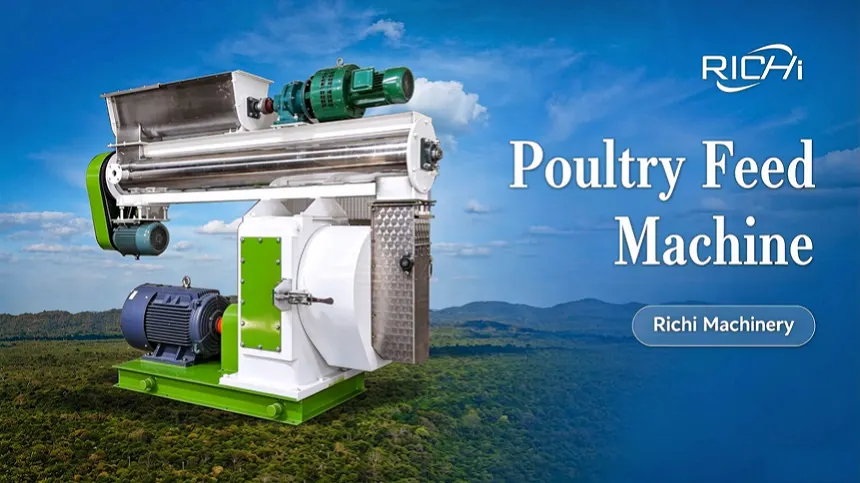
A pellet line needs a grinder, a mixer, a conditioner, a pellet mill, a cooler, and often a crumbler if crumbles are the target. It also needs a boiler for steam and adequate power for the mill. The capital cost is several times that of a mash line.
A crumble line adds a crumbler and a screening step to separate fines from usable crumbles. The fines are usually recycled through the pellet mill, which affects capacity calculations.
This is where equipment matching becomes critical. A farm that buys a poultry feed processing machine without deciding on the feed form first will end up with either unused capacity or missing stages. The feed form decision should come before the equipment decision, not after.
The Cost Trade-Off
The economics of feed form come down to a simple comparison: does the improvement in feed efficiency justify the additional processing cost?
For pellets, the additional cost includes energy for steam and pelleting, labor for operating and maintaining the pellet mill, depreciation on the additional equipment, and the cost of dies and rollers. Against that, the farm gains better feed conversion, less waste, and easier handling.
For crumbles, the additional cost is the crumbling step plus the recycling of fines. The gain is better performance in young birds.
For mash, the cost is lowest and the efficiency is lowest. The gain is simplicity and low capital investment.
There is no universal answer. A farm feeding a few hundred layers may find that mash is perfectly adequate. A farm feeding tens of thousands of broilers will almost certainly find that pellets pay back quickly. A farm raising its own pullets may find that crumbles are worth the extra step for the first few weeks.
The calculation should be done with the farm’s own numbers, not with general assumptions.
Storage and Handling Differences
Feed form affects storage and handling in ways that are easy to overlook.
Mash is bulky and dusty. It needs more storage volume per ton, and it can bridge in bins and feeders. It also generates dust that settles on equipment and in the air.
Pellets are dense and free-flowing. They store more efficiently and handle better in automatic systems. They are also more durable in transport, which matters for farms that sell feed or move it long distances.
Crumbles are less durable than pellets and generate more fines during handling. They need gentler handling and more frequent screening to maintain quality.
Moisture control matters for all three forms, but especially for pellets and crumbles. Poorly cooled pellets will sweat in storage and mold. Crumbles expose more surface area, which increases moisture uptake risk.
Feed Form and Bird Type
Different birds need different feed forms at different stages.
Broilers are typically started on crumbles or fine pellets, then switched to larger pellets as they grow. The switch supports rapid growth and high feed intake.
Layers are often fed mash or pellets, depending on the production system. Some markets prefer mash for layers because it allows the bird to regulate intake more naturally. Others prefer pellets for efficiency.
Breeders and parent stock often receive specific feed forms to control intake and body weight. Crumbles and pellets are common, with careful attention to nutrient density.
Turkeys and ducks have their own requirements. Turkeys generally do well on pellets. Ducks can handle mash, pellets, or crumbles depending on age and system.
The point is that feed form is not a single choice for the whole farm. It can vary by bird type, age, and production stage.
Matching Feed Form to Market Demand
Farms that sell feed, not just use it, have an additional consideration. Feed form affects what customers want and what they are willing to pay.
In some markets, pellets command a premium because customers associate them with quality. In others, mash is preferred because it is cheaper and customers are accustomed to it. Crumbles occupy a niche for young stock.
A farm that produces feed for sale should understand its market before investing in pelleting equipment. Producing pellets that no one wants to buy is worse than producing mash that sells reliably.
For farms that want to explore the range of equipment available for different feed forms and capacities, a 1t/h poultry feed machine price gives a reference point for small-scale entry. But the feed form decision should come first, because it determines what that machine actually needs to do.
Making the Decision
The decision between mash, pellets, and crumbles comes down to a few questions:
What birds are being fed? Young birds need crumbles. Fast-growing birds benefit from pellets. Layers can be fed either, depending on the system.
What is the scale? Small flocks rarely justify pelleting. Large flocks usually do.
What is the labor situation? Pellets reduce handling labor. Mash increases it.
What is the capital budget? Mash requires the least investment. Pellets and crumbles require more.
What does the market want? If feed is sold, customer preference matters as much as bird performance.
What is the energy cost? Pelleting uses more energy. In regions with high power costs, the calculation shifts.
Answering these questions honestly usually points to a clear choice. The mistake is choosing a feed form because it sounds better, without checking whether it fits the farm’s actual conditions.
Conclusion
Mash, pellets, and crumbles are not competing products. They are different tools for different situations. Mash offers simplicity and low cost. Pellets offer efficiency and handling benefits. Crumbles offer a stage-specific solution for young birds.
The right choice depends on the birds, the scale, the labor, the budget, and the market. Farms that make this decision deliberately, before buying equipment, get better results than farms that buy equipment first and figure out the feed form later.
For farms that want to match equipment to a specific feed form and production scale, Richi Pellet Mill provides equipment and project support across mash, pellet, and crumble systems.