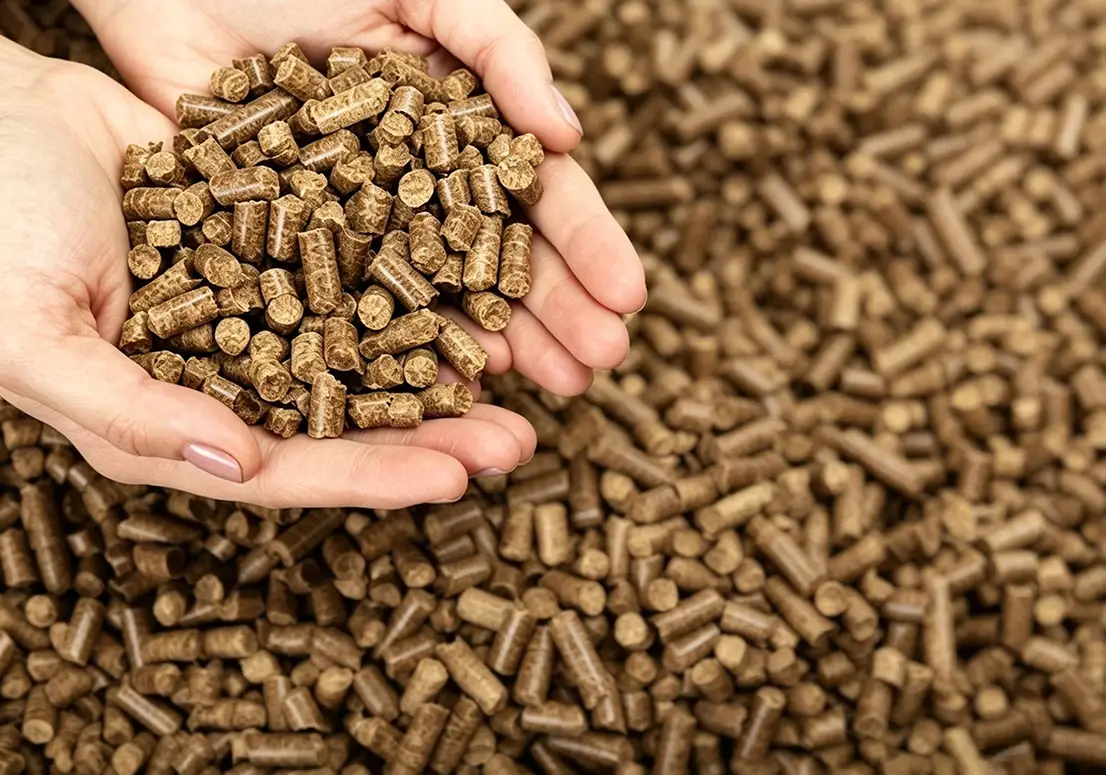



Wood residues are widely used in biomass fuel production, wood pellet manufacturing, animal bedding, composting, and other biomass processing applications. Sawdust, wood chips, branches, bark, wood shavings, forestry residues, and wood-processing waste can all become valuable raw materials when they are properly processed.
However, raw wood materials are rarely ready to enter a pellet mill or other downstream equipment directly. Their size, shape, moisture content, and bulk density can vary significantly. Large pieces may need to be chipped or crushed first, while smaller materials may require fine grinding to achieve the particle size needed for the next processing stage.
This is why wood crushing and grinding play an important role in biomass processing efficiency.
A properly selected sawdust hammer mill can reduce wood residues into a more suitable particle size, improve material uniformity, support efficient drying, and prepare biomass for pelletizing or briquetting.
Wood crushing is not simply about making material smaller. It is about creating the right physical characteristics for the entire production process.
This article explains how wood crushing improves biomass processing efficiency, why particle size matters, how hammer mills work, and how crushing equipment can be integrated into a complete biomass processing line.
What Is Wood Crushing?
Wood crushing is the process of reducing large or irregular wood materials into smaller particles.
Depending on the raw material and final application, different types of equipment may be used.
Common equipment includes:
- Wood chippers
- Wood crushers
- Hammer mills
- Fine grinders
- Disc mills
- Pulverizers
- Shredders
The appropriate equipment depends on the original material.
For example, large logs or branches may first need a wood chipper.
Wood chips may then be processed by a crusher or hammer mill.
Fine sawdust may require further grinding when a smaller particle size is needed.
Therefore, a biomass processing line may contain several size-reduction stages rather than a single crushing machine.
Why Particle Size Matters in Biomass Processing
Particle size affects almost every downstream processing stage.
It influences:
- Drying speed
- Material handling
- Feeding stability
- Pellet formation
- Pellet density
- Briquette quality
- Storage
- Transportation
- Energy consumption
If particles are too large, they may not pass through the pellet mill die effectively.
If particles are too fine, grinding energy may increase unnecessarily and dust generation may become more significant.
The objective is therefore not to produce the smallest possible particles.
The objective is to achieve a suitable and relatively uniform particle size for the intended application.
How Wood Crushing Improves Biomass Processing
Wood crushing can improve biomass processing efficiency in several ways.
The main benefits include:
- Reducing oversized material
- Improving particle-size uniformity
- Increasing surface area
- Improving drying performance
- Supporting pelletizing
- Improving material feeding
- Reducing blockages
- Improving mixing
- Increasing process stability
- Making better use of wood residues
These benefits are closely connected.
For example, reducing particle size increases surface area. Increased surface area can improve moisture transfer during drying. More uniform dried material can then improve pelletizing stability.
Therefore, crushing can influence the entire production line.
1. Reducing Oversized Wood Materials
Raw wood residues often contain material that is too large for downstream equipment.
Examples include:
- Large wood chips
- Branches
- Wood blocks
- Bark pieces
- Furniture-processing residues
- Coarse sawmill waste
These oversized pieces can cause:
- Conveyor blockages
- Feeding problems
- Pellet mill overload
- Uneven drying
- Equipment wear
A suitable crushing or chipping stage can reduce these materials to a manageable size.
2. Improving Particle-Size Uniformity
Uniform particle size is important for stable biomass processing.
If a material stream contains very large pieces mixed with fine dust, different particles will behave differently inside the dryer and pellet mill.
Large particles may remain wet while fine particles become dry.
This creates moisture variation.
Similarly, oversized particles may be difficult to compress into pellets.
A crusher or hammer mill can reduce this variation and create a more consistent feedstock.
3. Increasing Surface Area
When wood is reduced into smaller particles, its total surface area increases.
This is particularly important for drying.
Consider a large wood chip and several smaller particles made from the same amount of wood.
The smaller particles expose more surface area to hot air.
This can make heat and moisture transfer more efficient.
Therefore, crushing before drying can improve the performance of the drying stage.
4. Improving Wood Drying
Moisture is one of the most important variables in biomass processing.
Wet wood residues often need to be dried before pelletizing.
Particle size directly affects drying behavior.
Large particles may take longer to dry because moisture inside the material has a longer path to travel before reaching the surface.
Smaller particles generally provide more surface area for moisture evaporation.
A typical biomass process may therefore be:
Wood Waste → Crushing → Drying → Pelletizing
By controlling particle size before drying, the plant can achieve more predictable moisture removal.
However, excessive grinding should be avoided because producing unnecessarily fine particles can increase electricity consumption and dust loading.
5. Supporting Pellet Production
Wood pellet production requires suitable raw material characteristics.
A typical process is:
Raw Wood → Chipping/Crushing → Grinding → Drying → Pelletizing → Cooling → Screening → Packing
The grinding stage prepares the material for pelletizing.
The exact required particle size depends on:
- Wood species
- Raw material type
- Pellet diameter
- Pellet mill design
- Die configuration
- Production capacity
- Desired pellet quality
In many applications, the raw material needs to be sufficiently fine and uniform to pass through the die and form stable pellets.
A properly selected sawdust hammer mill can help achieve the required feed size.
What Is a Sawdust Hammer Mill?
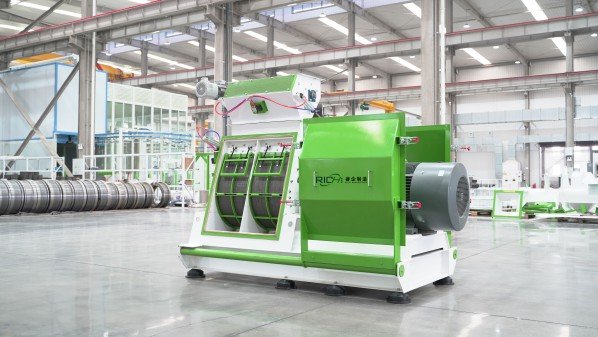
A sawdust hammer mill is a grinding machine designed to reduce biomass materials into smaller particles.
It typically consists of:
- Grinding chamber
- Rotor
- Hammers
- Screen
- Feeding system
- Discharge system
- Drive motor
- Bearings
- Housing
The material enters the grinding chamber and encounters rapidly rotating hammers.
The hammers impact the material repeatedly.
Once particles become small enough to pass through the screen, they leave the grinding chamber.
The screen therefore plays an important role in determining the final particle size.
(Learn more: https://pelletisingmachine.com/sawdust-hammer-mill/)
How a Hammer Mill Works
The working principle is relatively simple.
Step 1: Feeding
Wood material enters the hammer mill through a controlled feeding system.
Step 2: Impact Grinding
The rotating rotor drives the hammers at high speed.
The hammers strike the wood particles and break them into smaller pieces.
Step 3: Particle Movement
The particles circulate inside the grinding chamber.
Larger particles continue to be impacted until their size is reduced.
Step 4: Screening
The ground material passes through the screen once it reaches the required size.
Step 5: Discharge
The finished particles are discharged and transferred to the next processing stage.
This continuous process makes hammer mills suitable for industrial biomass production.
Why Screen Selection Matters
The screen is one of the most important components of a hammer mill.
Different screen openings produce different particle-size distributions.
A smaller screen opening generally results in finer material, while a larger opening allows larger particles to pass through.
However, screen selection should consider more than final particle size.
A very fine screen may:
- Increase grinding energy
- Reduce throughput
- Increase heat generation
- Increase wear
A larger screen may increase capacity but produce particles that are too coarse for some applications.
Therefore, screen selection should be based on the requirements of the final product.
Wood Crushing Before Drying
In many biomass plants, coarse material is reduced in size before entering the dryer.
This can improve drying efficiency by increasing surface area and improving material distribution.
For example:
Large Wood Waste
↓
Wood Chipping
↓
Hammer Mill Grinding
↓
Drying
↓
Pelletizing
The exact process depends on the starting material.
If the incoming material is already fine sawdust, a full crushing stage may not be necessary.
The process should therefore be customized according to raw-material characteristics.
Wood Crushing After Drying
In some applications, grinding can also take place after drying.
This may be suitable when the raw material has characteristics that make pre-drying grinding less practical.
The decision depends on:
- Material moisture
- Material hardness
- Particle size
- Dryer design
- Grinding equipment
- Energy consumption
- Final product requirements
Both pre-drying and post-drying grinding can be used in biomass processing, depending on the specific project.
Crushing and Energy Consumption
Grinding consumes electricity.
Therefore, efficient size reduction requires finding the right balance.
Grinding material to a smaller size than necessary can increase energy consumption without providing additional benefits.
For example, if a pellet mill can efficiently process a certain particle size, grinding the material to an extremely fine powder may not be economically justified.
An efficient biomass process should therefore use:
The minimum necessary grinding + the required particle size
rather than maximum grinding.
How Moisture Affects Wood Grinding
Moisture can influence grinding performance.
Very wet wood materials may be more difficult to grind efficiently.
Wet particles can:
- Stick to screens
- Block the grinding chamber
- Reduce throughput
- Increase power consumption
- Create unstable feeding
However, the ideal moisture for grinding depends on the equipment and material.
This is another reason why crushing and drying should be considered together when designing a biomass production line.
Crushing and Biomass Fuel Production
Wood crushing is particularly important for fuel pellet production.
A typical fuel pellet plant may process:
- Sawdust
- Wood chips
- Forestry residues
- Wood waste
- Wood shavings
- Bark
These materials are first prepared and then processed into uniform feedstock.
After crushing and drying, the material enters the pellet mill.
The pellet mill compresses the prepared biomass through a die to form dense fuel pellets.
Proper particle size can help improve:
- Pellet formation
- Pellet density
- Production stability
- Die utilization
- Material feeding
Crushing and Biomass Briquette Production
The same principle applies to biomass briquettes.
Large wood waste may need to be crushed before entering a briquette press.
A typical process is:
Wood Waste → Crushing → Drying → Fine Grinding → Briquetting → Cooling → Packing
If the particles are too large, compression may be inconsistent.
If the material is too wet, the briquettes may not form properly.
Therefore, crushing and drying are both important preparation steps.
Crushing and Animal Bedding Production
Wood residues can also be processed into animal bedding.
Sawdust and wood shavings are commonly used for bedding applications.
In this case, the desired particle size may be different from fuel pellet production.
For bedding, producers may prioritize:
- Absorbency
- Particle size
- Low dust
- Moisture control
- Comfortable material texture
Therefore, the grinding system should be selected according to the final bedding specification.
Crushing and Biomass Storage
Particle size also affects storage.
Very coarse material can be difficult to handle.
Extremely fine material can increase dust accumulation.
A suitable particle-size distribution can improve:
- Conveyor performance
- Hopper discharge
- Storage utilization
- Material flow
- Dust management
Proper storage design should also consider moisture and fire safety.
How Crushing Improves Material Feeding
Stable feeding is important for industrial biomass processing.
A material with large, irregular pieces may bridge inside:
- Hoppers
- Bins
- Screw conveyors
- Feeders
This can cause interruptions.
Reducing the material to a more uniform size can improve flow characteristics.
However, excessively fine material can also create flow problems due to poor bulk behavior.
Therefore, the correct particle size must be selected for the feeding system.
How Crushing Improves Mixing
Particle size uniformity also improves mixing.
In biomass fuel production, different raw materials may be blended.
For example, a plant may mix:
- Sawdust
- Wood chips
- Bark
- Forestry residues
If the particle sizes are dramatically different, the mixture may separate during handling.
Grinding can reduce particle-size differences and create a more homogeneous feedstock.
This can improve consistency in downstream processing.
Crushing and Pellet Quality
Particle size is one of several factors that affect pellet quality.
Other factors include:
- Moisture
- Wood species
- Raw-material composition
- Die compression
- Roller condition
- Feed rate
- Pellet mill settings
- Cooling
- Screening
Proper grinding can provide a more consistent raw-material structure.
However, crushing alone cannot guarantee high-quality pellets.
The entire pellet production process must be properly controlled.
How to Choose the Right Wood Crushing Equipment
Different materials require different machines.
Large Logs and Branches
A wood chipper may be appropriate for reducing large materials into chips.
Large Wood Waste
A heavy-duty crusher or shredder may be required.
Wood Chips
A crusher or hammer mill can further reduce the particle size.
Sawdust
A sawdust hammer mill can be used when finer and more uniform particles are required.
Extremely Fine Biomass
A specialized pulverizer or ultrafine grinder may be appropriate.
The equipment should therefore be selected based on the actual feedstock rather than the word “wood” alone.
Factors to Consider When Selecting a Sawdust Hammer Mill
When choosing a sawdust hammer mill, consider:
Raw Material
What type of wood will be processed?
Initial Particle Size
What is the size of the material entering the mill?
Moisture Content
How wet is the material?
Required Final Size
What particle size is required by the next processing stage?
Capacity
How many tons per hour need to be processed?
Screen Size
What screen openings are required?
Motor Power
What power is appropriate for the required grinding performance?
Wear Parts
How frequently will hammers and screens need inspection or replacement?
Dust Collection
What dust collection system is required?
Downstream Equipment
Will the material go to a dryer, pellet mill, briquette press, or another process?
These factors should be considered together.
Common Problems in Wood Crushing
Excessive Particle Size
Possible causes include:
- Screen openings are too large
- Hammers are worn
- Rotor speed is unsuitable
- Feed material is too large
Low Grinding Capacity
Possible causes include:
- Excessive moisture
- Improper feeding
- Blocked screen
- Worn hammers
- Incorrect machine selection
High Power Consumption
Possible causes include:
- Excessively fine grinding
- High moisture
- Overloading
- Poor maintenance
- Unsuitable screen configuration
Uneven Particle Size
Possible causes include:
- Mixed feedstock
- Improper screen selection
- Uneven feeding
- Inconsistent raw-material size
How to Improve Wood Crushing Efficiency
Several practical measures can improve grinding performance.
1. Pre-Process Large Material
Use a chipper or coarse crusher before the hammer mill when necessary.
2. Control Moisture
Avoid feeding material with unsuitable moisture content.
3. Select the Correct Screen
Match the screen opening to the required final particle size.
4. Maintain Hammers
Worn hammers reduce grinding efficiency.
5. Maintain Screens
Blocked or damaged screens can reduce capacity.
6. Use Stable Feeding
Avoid sudden overloading of the grinding chamber.
7. Use Proper Dust Collection
Maintain stable airflow and reduce dust accumulation.
8. Avoid Excessive Grinding
Produce the required particle size rather than unnecessarily fine powder.
Dust Collection in Wood Grinding
Wood grinding can generate a significant amount of dust.
A complete industrial system may include:
- Cyclone
- Bag filter
- Dust collector
- Exhaust fan
- Ducting
- Spark/fire protection where required
Dust management helps maintain a cleaner working environment and supports stable equipment operation.
Because fine biomass dust can be combustible, appropriate fire and explosion prevention measures should be considered during system design.
Automation of Wood Crushing Systems
Modern biomass plants can automate the grinding process.
An automatic control system can monitor:
- Feeding rate
- Motor load
- Material flow
- Fan operation
- Dust collection
- Equipment alarms
If the grinding load becomes too high, the feeding system can be adjusted.
This can help prevent overloads and maintain stable production.
Automation becomes particularly valuable in large biomass pellet plants operating continuously.
Wood Crushing in a Complete Biomass Production Line
Wood crushing should be designed together with the rest of the production process.
For example, a complete wood pellet production line may include:
Raw Material Receiving
↓
Cleaning
↓
Chipping
↓
Crushing/Grinding
↓
Drying
↓
Pelletizing
↓
Cooling
↓
Screening
↓
Packing
↓
Storage
Each stage affects the next.
The grinding system should therefore be matched to the dryer.
The dryer should be matched to the pellet mill.
The pellet mill should be matched to the final product requirements.
This integrated approach is more effective than selecting individual machines independently.
How RICHI Designs Biomass Processing Solutions
RICHI Machinery can provide customized biomass processing solutions for wood pellets, biomass fuel, and other wood-residue applications.
Depending on the raw material and final product, the complete system may include:
- Wood chipper
- Crusher
- Sawdust hammer mill
- Screening equipment
- Wood dryer
- Hot-air furnace
- Cyclone
- Dust collector
- Conveyors
- Pellet mill
- Pellet cooler
- Vibrating screen
- Packing machine
- Electrical control system
The equipment configuration can be adjusted according to:
- Raw-material type
- Initial moisture
- Particle size
- Required final size
- Production capacity
- Final product
- Available heat source
- Plant layout
RICHI can also provide turnkey engineering services covering process design, equipment manufacturing, transportation, installation, commissioning, operator training, and after-sales technical support.
Frequently Asked Questions
Why is wood crushing important in biomass processing?
Wood crushing reduces oversized material, improves particle-size uniformity, increases surface area, supports drying, and prepares biomass for pelletizing, briquetting, or other downstream applications.
What is a sawdust hammer mill?
A sawdust hammer mill is a grinding machine that uses rapidly rotating hammers and a screen to reduce sawdust and other biomass materials into smaller particles.
Is a hammer mill suitable for wood chips?
Yes, a suitable hammer mill can further reduce wood chips into smaller particles, although large chips may require pre-crushing or chipping first.
Does crushing improve wood drying?
Yes. Reducing particle size can increase surface area and improve contact between biomass and hot air, which can support more efficient moisture removal.
Should wood be crushed before or after drying?
Either approach can be used depending on the raw material and process design. Large materials are often reduced before drying, while some materials may be ground after drying.
What particle size is needed for wood pellets?
There is no universal particle size because requirements depend on pellet diameter, wood species, raw material characteristics, and pellet mill design. The material should generally be sufficiently fine and uniform for stable pelletizing.
Does finer grinding always improve pellet quality?
No. Excessive grinding can increase energy consumption without providing additional benefits. The optimum particle size should be determined according to the pelletizing process.
How does moisture affect hammer mill performance?
Excessively wet material can reduce grinding efficiency, cause material sticking, block screens, and increase energy consumption.
Does a hammer mill need a dust collector?
Industrial biomass grinding systems generally require appropriate dust collection. The exact configuration depends on material properties, production capacity, equipment design, and applicable safety requirements.
How do I choose a hammer mill for sawdust?
Consider raw-material moisture, initial particle size, required final size, production capacity, screen configuration, motor power, wear parts, dust collection, and the requirements of the downstream equipment.
Conclusion
Wood crushing is an essential preparation stage for many biomass processing applications.
By reducing oversized wood materials and creating a more suitable particle-size distribution, crushing can improve material handling, drying performance, feeding stability, pelletizing, briquetting, and overall production consistency.
A properly selected sawdust hammer mill can play an important role in reducing sawdust and other wood residues to the particle size required by downstream equipment.
However, the smallest possible particle size is not necessarily the best choice. Efficient biomass processing requires a balance between particle size, moisture, grinding energy, drying requirements, and final product specifications.
For a complete biomass fuel or wood pellet production project, the crushing system should be designed together with the chipper, dryer, pellet mill, cooling system, screening equipment, dust collection system, conveyors, and packing equipment.
With appropriate size-reduction technology and integrated process design, wood residues can be converted more efficiently into valuable biomass fuel, pellets, briquettes, bedding, and other useful products.