
Producing floating fish feed consistently is not simply a matter of running raw materials through a production line. Feed quality can change when the formula, moisture level, grinding fineness, extrusion conditions, or drying process changes.
This becomes especially noticeable when a feed plant produces several products for different fish species or growth stages. A pellet that performs well for one formula may not behave the same way when the ingredient ratio changes.
For this reason, feed producers need to look at the entire production process instead of focusing on one machine.
Good floating fish feed should have a suitable pellet size, stable shape, adequate water stability, and predictable floating performance. At the same time, the production process needs to remain efficient enough to support the target output.
The following factors can help producers improve consistency and reduce common problems during daily operation.
Start With Consistent Raw Materials
Raw material quality is the foundation of feed production.
Even if the equipment operates normally, significant changes in raw material properties can affect the finished pellets.
Corn, wheat, soybean meal, fish meal, rice bran, and other ingredients may vary in moisture, particle size, protein content, and starch content depending on their source and storage conditions.
These differences can change the way the feed behaves during processing.
For example, a formula containing more starch may expand differently during extrusion than a high-protein formula. Likewise, materials with excessive moisture can change the amount of water required during processing.
Feed producers should therefore establish basic quality requirements for incoming materials.
The storage environment also matters. Ingredients should be protected from rain, excessive humidity, contamination, and other conditions that can cause deterioration.
A stable raw material supply makes it easier for operators to maintain stable processing conditions.
Control the Grinding Process
Grinding is often considered a simple preparation step, but it can have a noticeable effect on final feed quality.
Large particles may make mixing less uniform and can create difficulties during extrusion.
On the other hand, grinding everything to an unnecessarily fine size can increase power consumption and reduce production efficiency.
The appropriate particle size depends on the formula and the target pellet diameter.
A feed designed for small fish may require finer raw material processing than feed intended for larger fish.
Operators should also monitor the condition of screens, hammers, and other wear parts in the grinding system.
As these components wear, the particle size distribution can gradually change.
This type of change may not be obvious at first, but it can eventually affect mixing and extrusion stability.
Regular inspection therefore helps maintain a consistent grinding result.
Keep the Mixing Process Uniform
After grinding, the ingredients need to be distributed evenly throughout the mixture.
This is particularly important when a formula contains small quantities of vitamins, minerals, additives, or other functional ingredients.
Poor mixing can cause differences between portions of the same batch.
One section of the mixture may contain a higher concentration of a particular ingredient, while another section contains less.
The mixer should therefore be operated according to an appropriate loading ratio and mixing time.
Overloading the mixer can reduce mixing quality, while excessive mixing time may waste energy without providing additional benefits.
Liquid ingredients also require attention.
Oil or other liquid additives can influence the physical properties of the mixture. They should be introduced in a way that allows them to distribute evenly rather than forming concentrated areas.
A stable mixing process gives the extrusion section a more consistent material to work with.
Why Moisture Management Matters
Moisture is one of the most important variables in floating fish feed production.
The material entering the extrusion system needs an appropriate moisture condition.
If the feed mixture is too dry, the extrusion process may become unstable. The material can become difficult to process, and the machine may require more mechanical energy.
If the moisture level is too high, the feed may expand differently and create additional work for the drying system.
The correct moisture level depends on the formula and the equipment configuration.
Therefore, operators should avoid treating moisture as a fixed number that applies to every feed product.
Instead, they should observe how the material behaves during production and adjust the process according to the actual formula.
Consistent moisture management can also make the downstream drying process more predictable.
Understand the Role of Extrusion
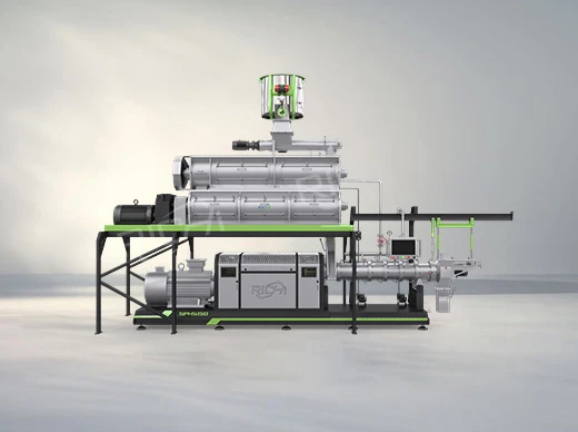
Extrusion is the process that gives floating fish feed much of its characteristic physical structure.
Inside the extrusion chamber, the feed material is subjected to mechanical pressure, heat, moisture, and friction.
As the material moves through the system, starch and other components undergo physical changes.
When the material exits the die, the sudden pressure reduction causes moisture to expand rapidly. This can create a porous internal structure and reduce the bulk density of the pellet.
When the density is sufficiently low, the pellet can remain on the water surface.
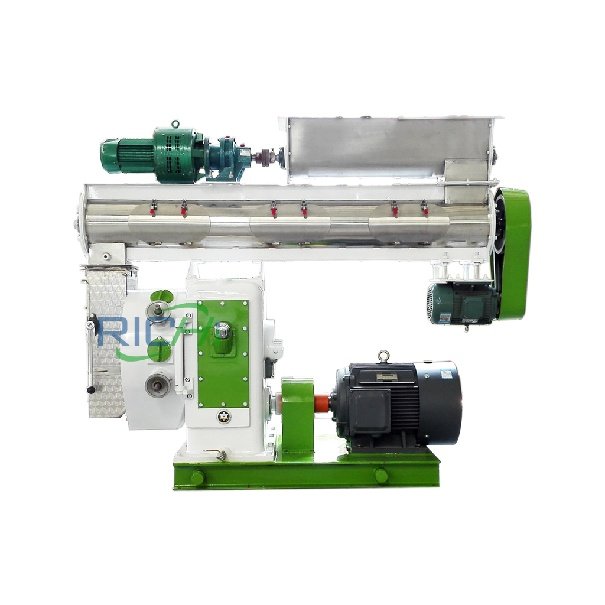
A floating fish feed extruder is therefore not simply compressing ingredients into a pellet. It is helping control the structure and density of the finished product.
The exact operating conditions need to be matched to the formula and desired feed characteristics.
Choose Equipment According to the Actual Formula
Equipment capacity should not be evaluated independently from the feed formula.
Two plants with the same nominal production target may require different operating conditions because their formulas are different.
A producer planning a small commercial project may find a 1 T/H floating fish feed extruder for sale suitable for its expected demand. However, the quoted output should always be checked against the actual formula, pellet diameter, moisture content, and processing conditions.
This is more useful than comparing machines based only on the number shown in a product catalog.
Buyers should also consider whether the equipment can accommodate future products.
If the company plans to produce different pellet diameters later, the extrusion system should allow appropriate adjustments.
The right machine is not necessarily the one with the highest rated output. It is the one that can provide stable production under the conditions the plant actually expects to use.
Pay Attention to Pellet Diameter
Pellet diameter affects feeding efficiency and product acceptance.
Different fish species and growth stages require different pellet sizes.
Small fish generally need smaller pellets that they can consume easily. Larger fish can handle larger feed particles.
A commercial feed plant may therefore need to produce several pellet diameters.
Changing the die and cutter settings allows the production system to adapt to different specifications.
However, frequent product changes can reduce effective production time.
If a plant changes pellet size many times each day, operators need an efficient changeover procedure.
Production planning can also help. Similar products can be scheduled together to reduce unnecessary equipment adjustments and cleaning time.
Control the Cutting Process
Once the extruded material leaves the die, it needs to be cut into individual pellets.
The cutter setting influences pellet length and appearance.
If the pellets are too long, fish may have difficulty consuming them. If they are too short, the product may not have the desired appearance or feeding characteristics.
Cutting speed should therefore be matched to the extrusion rate and target pellet dimensions.
The cutter blades also need regular inspection.
Worn blades can produce irregular pellet shapes and may increase the amount of fines.
A simple maintenance schedule can prevent this problem from developing into a larger production issue.
Do Not Ignore Drying
Freshly extruded feed contains moisture and heat.
Drying reduces excess moisture so that the pellets can be stored safely.
The drying process needs to remove moisture without unnecessarily damaging the product.
Drying temperature, residence time, airflow, and material thickness can all affect the result.
If the dryer operates below its required capacity, wet pellets may accumulate at the outlet of the extrusion section.
This creates a bottleneck and can force operators to reduce extrusion output.
For this reason, the dryer should be matched to the expected output of the extrusion system.
An efficient production line maintains a balance between these two sections.
Why Cooling Comes After Drying
After drying, the pellets are still relatively warm.
Cooling brings the product closer to ambient temperature before screening and packaging.
This step helps prevent condensation problems inside packaging.
If warm feed is immediately sealed in bags, the temperature difference between the product and the surrounding environment can create moisture inside the package.
That moisture can negatively affect storage stability.
A properly sized cooler allows the product to stabilize before it enters the final handling stages.
Cooling also makes the finished pellets easier to transport and package.
Reduce Fines During Handling
Not all fines are created during extrusion.
Some can develop during drying, cooling, conveying, and packaging.
Excessive mechanical impact can break pellets and create unnecessary powder.
Conveying equipment should therefore be selected and operated with the physical properties of the finished feed in mind.
Long conveying distances, excessive drop heights, and aggressive handling can increase pellet damage.
Screening before packaging can remove fines and improve the appearance of the finished product.
If the production process allows it, suitable fines can sometimes be returned to the production system rather than discarded.
This can improve material utilization.
Keep the Production Line Balanced
A feed plant works as a connected system.
Grinding, mixing, extrusion, drying, cooling, screening, and packaging need to work at compatible capacities.
A bottleneck in one section can reduce the output of the entire plant.
For example, an extruder may theoretically produce several tons per hour, but if the dryer cannot process the same volume, overall production will still be limited by the dryer.
The same principle applies to packaging.
A large packaging machine cannot compensate for insufficient upstream production.
For this reason, equipment selection should be based on the complete production flow.
This is especially important when planning a new plant because correcting a capacity mismatch after installation can be expensive.
Maintain a Practical Production Schedule
Production scheduling can influence both efficiency and feed quality.
A plant that produces one formula for several hours may operate more efficiently than one that changes formulas every hour.
Frequent changes require cleaning, adjustments, die replacement, and process stabilization.
Where possible, producers can organize similar products together.
For example, products using similar formulas or pellet diameters can be scheduled consecutively.
This reduces the number of major adjustments required during a working day.
Production planning also helps coordinate raw material preparation, packaging, warehouse operations, and equipment maintenance.
The goal is to keep the plant moving steadily rather than constantly stopping and restarting.
Build a Simple Quality Control System
Quality control does not always require a complicated laboratory.
A basic production facility can monitor several practical indicators.
These may include raw material condition, moisture, pellet diameter, pellet appearance, bulk density, floating behavior, and final product moisture.
Operators can record these parameters for each production batch.
Over time, the records provide useful information.
If a problem appears, operators can compare the affected batch with previous production records and identify possible changes in raw materials or processing conditions.
Larger commercial plants may require more detailed laboratory testing according to their products and local regulations.
However, even a small plant benefits from consistent production records.
Train Operators Before Full Production
Equipment performance depends partly on operator experience.
A new operator may know how to start and stop a machine but still have difficulty adjusting it when the raw material or formula changes.
Training should therefore cover more than basic operation.
Operators should understand how moisture, particle size, formula composition, extrusion conditions, and drying affect the finished pellets.
They should also know how to identify unusual vibration, temperature, noise, material accumulation, or changes in output.
Early identification of these problems can prevent unnecessary downtime.
Training also helps operators use the equipment more efficiently and reduces avoidable wear.
Plan Preventive Maintenance
Preventive maintenance is usually less expensive than unexpected equipment failure.
Wear parts should be inspected according to a regular schedule.
For extrusion equipment, components exposed to continuous pressure and friction deserve particular attention.
The same principle applies to grinders, mixers, conveyors, dryers, coolers, and packaging equipment.
Maintenance records can help operators identify components that need replacement before they cause production interruptions.
Spare parts should also be managed carefully.
Critical components with long delivery times may need to be kept in stock, especially for plants located far from the equipment supplier.
A small investment in preventive maintenance can protect a much larger production schedule.
Consider Future Expansion
A new feed plant may begin with a modest production target.
However, if the business grows, the plant may need to produce more feed or introduce new products.
Future expansion should therefore be considered during the initial design stage.
The factory should reserve reasonable space for additional equipment where possible.
Electrical capacity, raw material storage, finished product storage, and material conveying should also be considered.
It is not necessary to install every future machine immediately.
Instead, the initial layout can leave room for expansion.
This approach can reduce the difficulty of upgrading the plant later.
Work With an Experienced Equipment Supplier
Choosing an equipment supplier is an important part of project planning.
The supplier should understand not only individual machines but also the relationship between different processing stages.
A complete solution may include raw material handling, grinding, mixing, extrusion, drying, cooling, screening, conveying, and packaging.
The supplier should also be able to discuss capacity, layout, installation, commissioning, and maintenance.
For international projects, communication and technical documentation can be particularly important.
A company such as Richi Manufacture can help buyers evaluate equipment configurations based on their production requirements and project conditions.
This type of cooperation can be useful when the buyer does not have extensive experience designing feed processing plants.
Ask for Project-Specific Information
Buyers should avoid making decisions based only on generic catalog information.
Before purchasing equipment, provide the supplier with as much project information as possible.
Useful information includes:
- Target production capacity
- Fish species
- Feed formulas
- Raw material types
- Pellet diameter
- Desired floating performance
- Working hours
- Factory dimensions
- Local power supply
- Packaging size
- Expected future production
The more specific the information, the more useful the equipment recommendation can be.
It also allows suppliers to identify possible bottlenecks before equipment is manufactured.
For companies that want to understand more about the manufacturer, production experience, and company background before making a purchasing decision, click to read more about the company.
Final Thoughts
Consistent floating fish feed production depends on many small details working together.
Stable raw materials make the process easier to control. Appropriate grinding improves mixing and extrusion. Accurate moisture management supports stable expansion. Correct extrusion conditions influence pellet density and floating performance.
Drying and cooling then prepare the pellets for storage, while screening and careful conveying help maintain the appearance and integrity of the finished product.
The production line should also be balanced according to the real output requirement. Selecting one high-capacity machine without considering downstream equipment can create bottlenecks rather than improving productivity.
For new projects, it is therefore better to begin with the feed products, raw materials, capacity, and factory conditions. Equipment can then be selected around those requirements.
A practical production plan can help control investment costs, improve daily operation, and leave room for future development. With the right combination of process design, equipment, operator training, and maintenance, a floating fish feed plant can achieve more stable production and better control over finished feed quality.